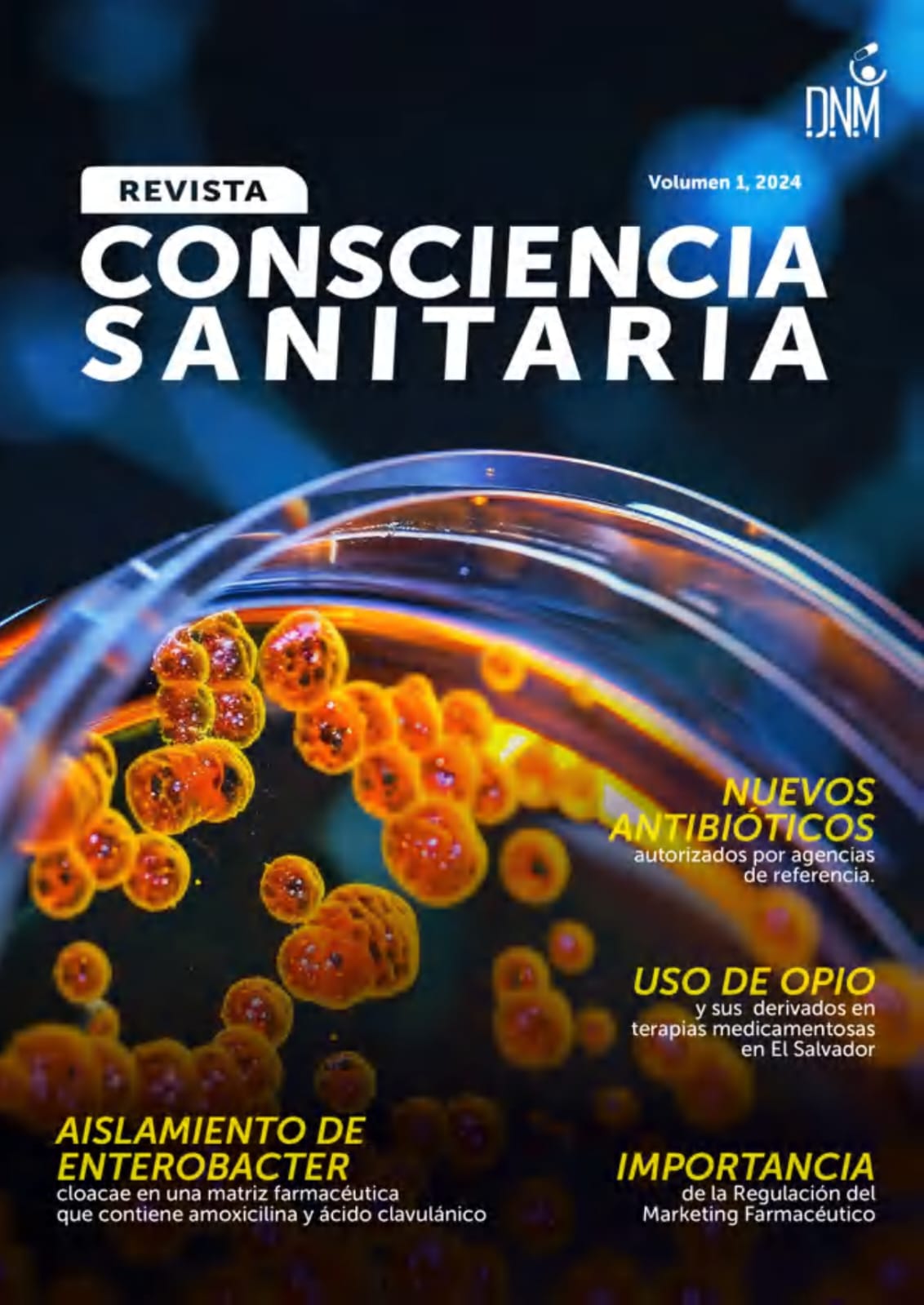
Isolation of Enterobacter cloacae in a pharmaceutical matrix containing amoxicillin and clavulanic acid
Palabras clave:
Enterobacter cloacae Complex, bacterial resistance, isolation, microbiology, objectionable microorganismsResumen
Background: in recent years, clinical importance has been detected for the Enterobacter cloacae Complex due to its high resistance to various antimicrobials and its association with their inactivation and degradation, and also for its nosocomial pathogenicity. Objective : to show the survival capacity of Enterobacter cloacae to a mixture of antimicrobial and betalactamase inhibitor. Method: the microbiological analysis method used in the present study corresponds to the direct method described in the general chapter 〈62 (Microbiological examination of non-sterile products: tests for specific microorganisms) of the Pharmacopoeia of the United States of America, which consists in placing the sample directly in the nutrient medium as preincubation, to complete the scheme with direct passages to broth and selective agar. Results: from the determination of objectionable microorganisms, microbial growth was obtained, which was purified to perform preliminary tests for identification, obtaining short gram-negative bacilli in staining; in the oxidase test, no color change was obtained on the strip test, which indicates a negative result, and in miniaturized galleries the identification gave Enterobacter cloacae with a probability percentage of 100%. The results were obtained in the microbiological analysis (objectionable microorganisms) of a pharmaceutical matrix evaluated in the Microbiological Analysis Quality Control Laboratory of the National Directorate of Medicines carried out in 2022. Conclusion: there is an evident resistance to antimicrobial drugs by Enterobacter cloacae, even when it comes to multi drugs, intended to block the action of betalactamases (which is the nature of the studied matrix) created by resistant microorganisms.
Referencias
1.García, C. (2018). Resistencia antimicrobiana. DIAGNOSTICO, 57(2) 79-81. https://doi.org/10.33734/diagnostico.v57i2.81
2.Silva, F. y Martinez, P. (2018). Complejo Enterobacter cloacae. Revista chilena de infectología, 35, 2. http://dx.doi.org/10.4067/s0716-10182018000300297
3.Organización Mundial para la Salud [OMS] (2021): Resistencia a los antimicrobianos.
4.Navarro F., Calvo J., Cantón R., Fernández F., Mirelis B. (2011) Detección fenotípica de mecanismos de resistencia en microorganismos gramnegativos, Enfermedades Infecciosas y Microbiología Clínica, 29, 524-534. https://doi.org/10.1016/j.eimc.2011.03.011
5.Farmacopea de los Estados Unidos de América [USP],2022. ÓPTIMAS PRÁCTICAS DE LABORATORIO MICROBIOLÓGICO, 1117.
6.Farmacopea de los Estados Unidos de América [USP],2022. Examen Microbiológico de Productos No Estériles: Pruebas de Microorganismos Específicos, 62.
7.Farmacopea de los Estados Unidos Mexicanos [FEUM] (2021). Pruebas para microorganismos específicos: Escherichia coli.
8.Farmacopea Europea [Ph. Eur.],2022. Examen Microbiológico de Productos no Estériles (prueba para microorganismos específicos) 2.6.13.
9.Farmacopea Británica, [BP], (2022) Examinación microbiológica de productos no estériles.
10.Farmacopea Británica, (2022) Propiedades promotoras del crecimiento e inhibitorias de los medios, idoneidad de la prueba y controles negativos.
11.Microgen Bioproducts Ltd (2009). Microgen GnA+B ID instructions for use. https://www.kemitekskimya.com.tr/files/101200b4084682.pdf
12.Microgen Bioproducts Ltd (2009). Gram Negative Bacillus Training Manual. https://www.kemitekskimya.com.tr/files/101200b4084682.pdf
13.Merck Millipore, (2021). MacConkey Broth acc. harm. EP/USP/JP ficha técnica. https://www.merckmillipore.com/GT/es/product/MacCONKEY-broth,MDA_CHEM105396?ReferrerURL=https%3A%2F%2Fwww.google.com%2F#anchor_DS